
Essential Safe Handling Tips for First-Time Bird Owners
Owning a pet bird is not like sharing a home with a dog or a cat. Parrots, cockatiels, and other companion birds are not domesticated in the same way; they remain intricately wild at heart, carrying instincts shaped over eons. In 2026, as more households welcome these intelligent feathered companions, understanding how to handle them safely has never been more crucial. Incorrect handling does not merely annoy a bird—it can crush its delicate body or shatter its trust, turning a potential bond into a tragedy. The following guidance distills the essentials every new guardian should absorb before that first touch.
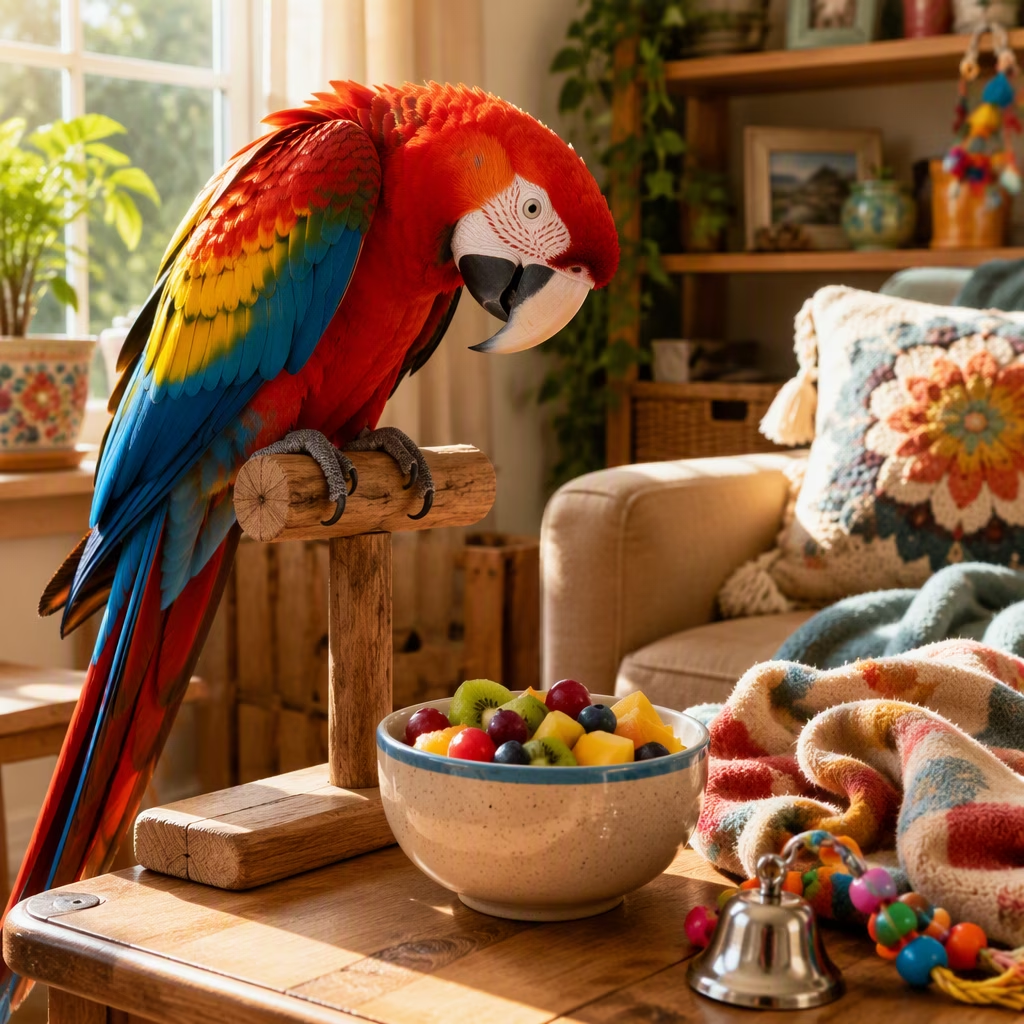
The Fragile Architecture Inside a Feather Coat
A bird’s skeleton is a marvel of evolutionary compromise: lightweight enough for flight yet so brittle that even a firm squeeze can snap a leg or rib. Think of a bird’s ribcage not as a solid shield but as an eggshell chalice — one careless press and a cascade of internal fractures can begin. Even more vulnerable is the respiratory system. Birds possess air sacs that extend into their bones, creating a continuous flow of air like a set of delicate bellows. Squeezing those bellows interrupts breathing and can cause rapid suffocation or fatal organ damage. Whether trimming nails or simply lifting the bird from a perch, a handler must imagine holding a living origami figure: support is essential, pressure is lethal. Never tighten the fingers around the body; instead, use a flat palm or a gently curved hand that allows the keel bone to rest without compression.
Step Up: The Bridge Over Troubled Water
If there is a single golden key to safe handling, it is the “step up” cue. Without it, every interaction risks becoming a wrestling match. A bird that does not willingly lift a foot onto an offered finger will often be chased, grabbed, or toweled, sending its fight-or-flight response into a fiery panic. That panic can cause the bird to crash against cage bars or thrash mid-air, leading to snapped blood feathers and concussive injuries. Teaching “step up” is akin to building a suspension bridge between two isolated islands — slowly, with patience, you create a reliable passage that eliminates terrifying jumps. Positive reinforcement using a favorite treat transforms the human hand from a predator’s claw into a safe perch. Once mastered, the command allows a guardian to move the bird calmly from cage to play stand, into a carrier, or away from danger, all without physical coercion.
Shoulder Perching: More Than a Pirate’s Pose
Movies and social media often showcase parrots riding on shoulders like feathery admirals, but experienced owners know this pose hides a razor’s edge. Placing a bird at face level is much like strapping a tiny, reactive dagger next to one’s eye. Even the sweetest cockatoo can deliver a deep, tissue-tearing bite if suddenly startled by a door slam, a shadow, or a stranger’s cologne. When a bird is on the forearm or held at waist height, the owner has time to read the body language — the pinning eyes, the fanned tail — and redirect before escalation. But a bird already on the shoulder has direct access to the most sensitive parts: lips, eyelids, nostrils. A single fright can result in permanent scarring or an emergency room visit. In 2026, behavioral consultants overwhelmingly recommend keeping the bird on a hand or forearm, treating the shoulder not as a perch but as a boundary that ensures mutual safety.
Wing Clipping: A Controversial Safety Net
Opinions on wing clipping continue to divide the avian community, yet from a handling-safety angle it serves as a temporary scaffold for trust. A bird with fully intact flight feathers can bolt at the first unfamiliar sound, and an owner’s reflex is often to lunge and grab — exactly the kind of sudden, desperate motion that can crush a bird’s body or cause a wing to wrench violently. Clipping the primary flight feathers of both wings does not ground the bird like a stone; it transforms its flight into a gentle, descending glide. This glide gives the guardian time to catch the bird calmly rather than snatch it from a panic-fueled trajectory. Think of it as training wheels on a bicycle: it prevents catastrophic falls while both parties learn balance and predictability. Clipping should always be performed by an avian veterinarian or an experienced professional, and as handling skills improve and the bond solidifies, many owners allow feathers to grow back under controlled recall training indoors.
Jewelry: A Magpie’s Lure on Your Body
Birds are drawn to small, bright objects with the same magnetic urgency that pulls a crow toward a glint of foil in a field. Earrings, necklaces, rings, and even polished buttons become irresistible targets for beak exploration. What begins as gentle nibbling can escalate to a swallowed gemstone, a torn earlobe, or a piece of metal lodged in the crop. Many an avian veterinarian has removed a diamond stud from a macaw’s digestive tract. Removing all jewelry before handling a bird is a simple ritual that prevents both property destruction and life-threatening obstructions. Instead, offer an approved substitute: a wooden bead toy, a stainless-steel foraging object, or a piece of untreated leather that can be destroyed without consequence. This redirects the bird’s natural foraging instinct away from your body and toward objects designed to be chewed.
Uniting Fragility and Respect
Safe handling is not about dominating a bird but about acknowledging its fundamental otherness. Unlike a puppy, a parrot will not read dominate-and-submit signals; it reads consistency and calm. When a guardian combines no-squeeze support, a fluent “step up,” shoulder boundaries, considered wing clipping, and jewelry-free interactions, the result is a choreography that honors the bird’s wild blueprint while allowing companionship to flourish. In 2026, the most skilled handlers do not restrain — they invite cooperation using an understanding of avian anatomy and psychology that turns every encounter into a conversation rather than a capture.
Information is adapted from ESRB, underscoring that just as game ratings and content descriptors help players anticipate risk and set boundaries, first-time bird owners should establish clear “handling rules” (like step-up training, avoiding shoulder perching, and removing jewelry) to prevent panic-driven accidents and protect both the bird’s fragile respiratory system and the handler’s face and hands.
Comments