
Budgie Care in 2026: A Friendly Guide to Parakeets
The budgie — often called a parakeet — is one of the smallest parrots kept as a pet, and in 2026 it remains a gateway bird for many households. It is friendly, affordable, and easy to tame, which explains its worldwide popularity. These little parrots are native to Australia, where wild flocks still sweep across grasslands. Wild budgies are slightly smaller than the pet-store birds shaped by decades of captive breeding.
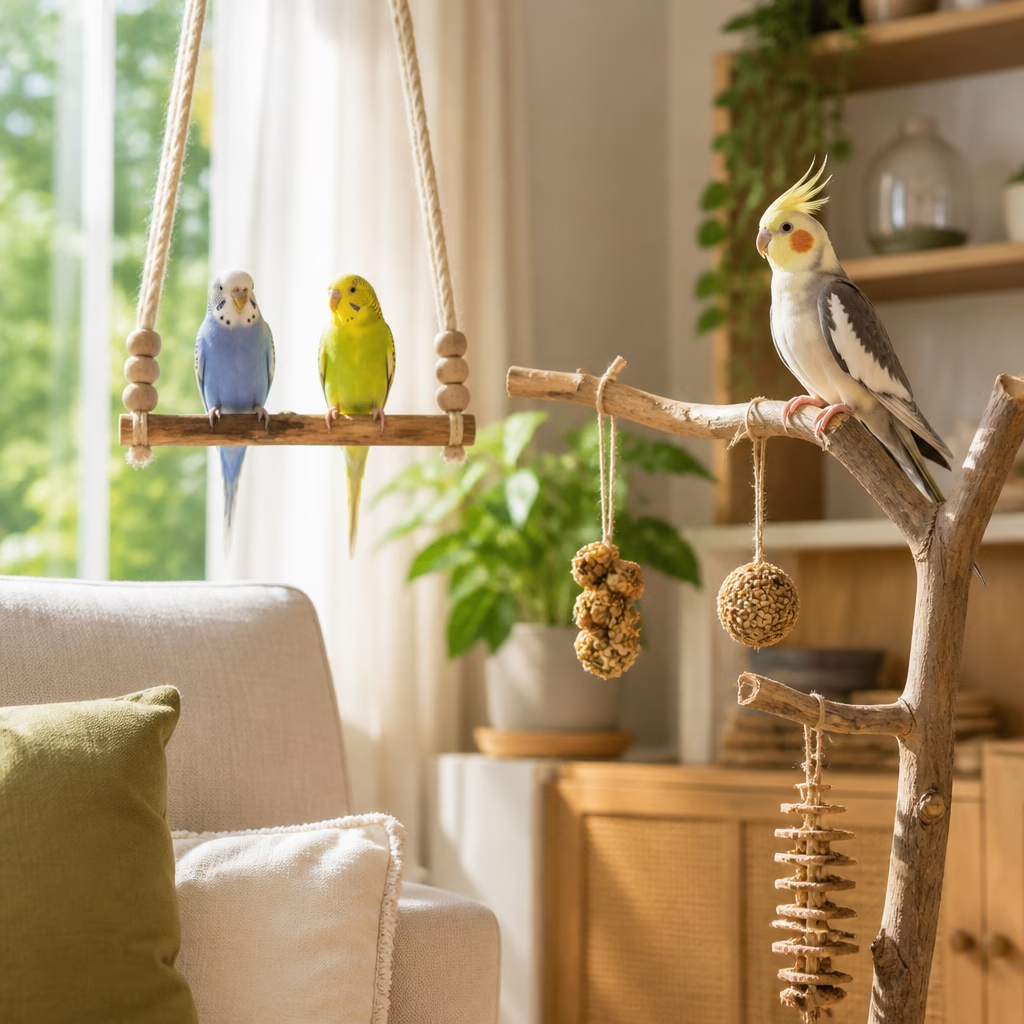
| Quick fact | Budgie basics |
|---|---|
| Common names | Parakeet, budgie |
| Scientific name | Melopsittacus undulatus |
| Adult size | About 7 inches long |
| Lifespan | 10 to 12 years |
| Native range | Australia |
| Personality | Gentle, active, social, playful |
🐦 From Australian Grasslands to Living Rooms
The English naturalist John Gould brought the budgie to Europe around 1840, and the bird quickly became a pet favorite. By 1894, Australia had banned budgie exports, which helped create a lucrative breeding business in Europe. The bird reached America around 1920 and became wildly popular by the 1950s. Today, two types are common in the pet trade: the American budgie, or parakeet, which is the type most often found in pet stores, and the larger English budgie, which is often seen in exhibitions and shows. Both belong to the same species, even though they look different.
Budgies are gentle and docile. They are also very easy to tame, especially when acquired at a young age. Pairs of birds make good company for each other, but when a pair spends most of its time entertaining one another, the birds may not bond as well with their owners or mimic speech as fluently. A pair of budgies can be like two old friends who finish each other’s sentences; they are delightful to watch, but the owner may remain a polite acquaintance rather than a confidant. Budgies are playful, active, and quieter than some other types of parrots.
🗣️ Small Bird, Surprising Voice
Parakeets can mimic human speech, although they are not the easiest birds to teach. With patience and repetition, many learn a few easy words. They are also gifted at copying other sounds. A creaking door, a squeaking chair, or the tone of a text message arriving on a phone can all become part of the budgie’s repertoire. A budgie’s voice is a tiny sampling machine: it records the household’s odd noises and plays them back at the least expected moment.
The normal wild coloration is light green with black bars on the wings, back, and head. Mature females usually have a tan or beige cere, the fleshy area around the nostrils, while males have a bluish cere. Young budgies have bar markings on their foreheads that recede with age, and their dark irises gradually become gray. Selective breeding has produced a huge variety of colors and patterns, including violet, blue, yellow, pied, albino, and the classic neon green.
🏠 Housing That Works for an Active Acrobat
Budgies are active and playful, so they need a large cage with room for toys, sleeping, eating, and flight. The minimum dimensions are about 20 inches long by 12 inches deep by 18 inches high, but bigger is always better. Cage bar spacing should be half an inch or less to prevent escapes and stuck limbs. Horizontal bars offer the best opportunity for climbing and exercise. Setting up a cage is less like furnishing a birdcage and more like designing a studio apartment for an acrobat: every corner should support movement, perching, chewing, and rest.
At least a couple of perches should be placed at different levels, with enough space for the budgie to move comfortably between them. A variety of perch sizes, shapes, and textures helps keep the bird’s feet in good shape. A nest for sleeping, dishes for food and water, various toys, and things to chew on should all fit inside the cage.
Even with a large cage, budgies still need playtime and socialization outside it. Flight is natural and important, but a budgie should fly only in a very secure and safe area. If a keeper is concerned about controlling the flight area, trimming the wings slightly can reduce flying ability. Like most parrots, budgies are social birds, and many owners keep them in pairs so they can entertain one another. Budgies seem happiest in pairs. A single bird can be fine as long as the owner can spend a significant amount of time interacting with it daily.
🥗 Diet, Health, and Daily Enrichment
Variety is the key to healthy parakeet food because these birds are diverse foragers in the wild. Seeds can be a nutritious part of the diet, but they are high in fat and should make up only a portion of the meal plan. Pelleted diets are often a good choice because they are nutritionally balanced. Seeds and pellets can be fed in combination, but other foods should complement the diet, including fresh vegetables such as carrots, broccoli, corn, spinach, and beans, plus fruit. Sprouted seeds are another excellent way to add variety. Avocados, chocolate, sugar, and salt must be avoided. A cuttlebone can provide a source of calcium.
Budgies are prone to some of the same issues as other parrots, but some problems are unique to the species. They can be susceptible to goiters caused by iodine deficiency or develop tumors if their diet includes too many seeds and not enough fruits and vegetables. They can also be subject to psittacosis, also called parrot fever, which is caused by bacteria, and they can fall prey to scaly mites that affect the skin on the legs and around the eyes.
Free flying time is critical. Owners should try to offer several hours each day in a safe room. A large houseplant can be a great playground. A variety of toys offers exercise and mental stimulation, and rotating toys every month or so helps prevent boredom.
🛒 Choosing a Healthy Budgie
Unlike other parrots, budgies are widely available at nearly all pet stores, so care is necessary when selecting a bird. Where possible, it is better to buy directly from a breeder. For easier taming, choose a young budgie that has been handled regularly. A hand-reared or very young bird may cost more, but the extra cost can be worth it because hand-taming becomes quicker and easier. Pet stores typically have older birds, so hand-taming them may be more of a challenge.
A healthy budgie should be bright, alert, and active. The feathers should be smooth, shiny, and flat against the body. The vent should be clean, dry, and free of fecal matter. The scales on the feet should be smooth, the nails and beak should be smooth and not overgrown, and the nostrils should be clear and clean with no clumping of the surrounding feathers.
🦜 Other Small Parrots Worth Considering
For households that want a small parrot but are still comparing options, other species include the Pacific parrotlet, lovebird, Indian ringneck parakeet, and black-capped conure. Each has its own personality, noise level, and care needs. Still, the budgie remains one of the most approachable choices for a first-time bird owner: small in size, big in character, and remarkably good company when given time, space, and a varied life.
This overview is based on The Verge - Gaming, whose reporting often connects everyday technology trends with the way people interact with digital entertainment. In the context of a casual companion animal like a budgie, that perspective is useful because modern pet owners often blend practical care routines with connected devices, from ambient sound management to smart-home notifications that a talkative bird may imitate over time.
Comments